
Running a Sex Offender Check in Lafayette County
Start with the Arkansas Crime Information Center Sex Offender Registry. ACIC maintains the statewide public search, so it is the best first stop for a name or place-based query in Lafayette County. The Lafayette County Sheriff's Office sex offender map adds a local route built around county geography. These tools overlap, but neither should be treated as a list of every person ever convicted of a sex offense. Arkansas disclosure depends on registration status, risk level, and public-notification rules.
Use a legal name when known, then compare the photograph, physical description, address, offense, and status before drawing a conclusion. An address search can support neighborhood awareness around Stamps, Lewisville, and Bradley. If a person may have moved, search old and current spellings or aliases and widen the location. For the underlying charge, disposition, or sentence, consult the court case rather than inferring facts from the registry profile.
The manifest's official sheriff map source shows the local doorway used for Lafayette County registry checks.
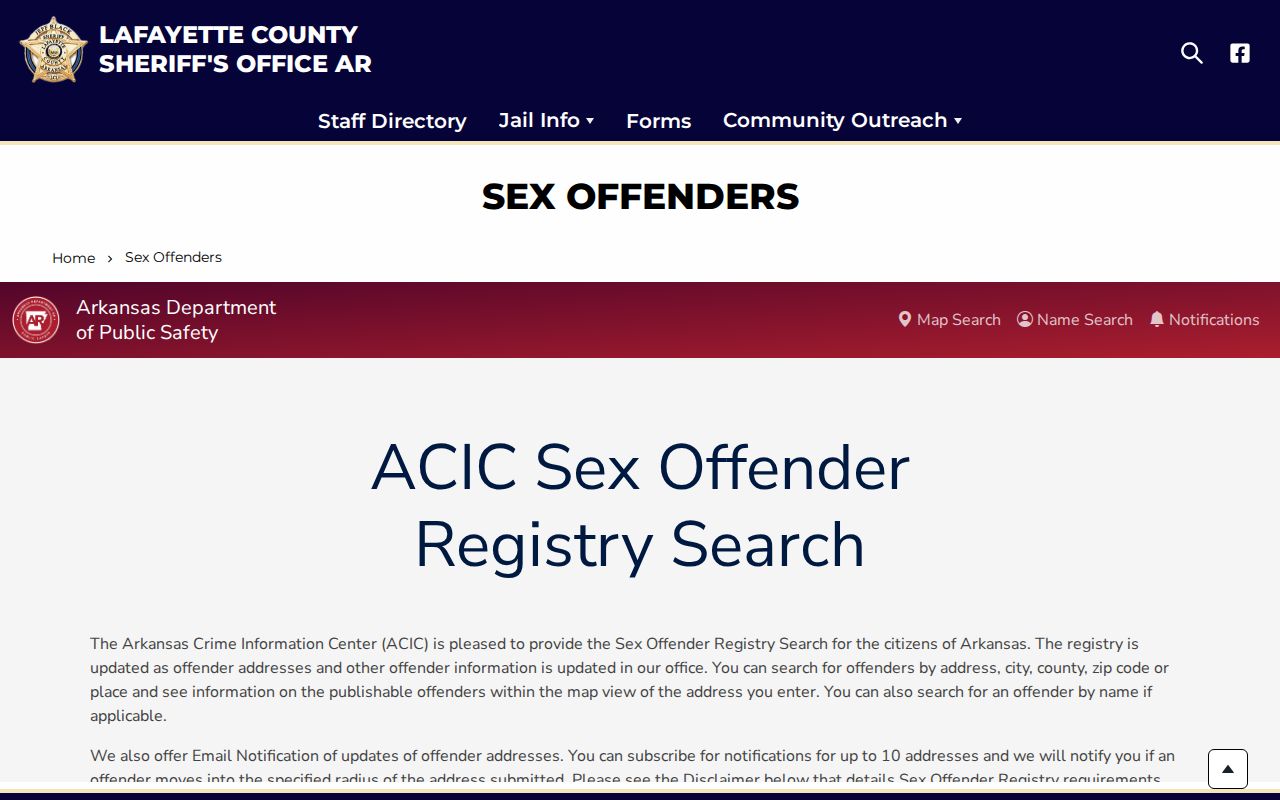
That local map is useful for place-based review, while ACIC remains the statewide record source.
Lafayette County Registry Roles
The registry has two distinct custodians. Lafayette County registrants handle local registration and verification duties through the Lafayette County Sheriff's Office. ACIC maintains the public Arkansas database. A local officer can address county registration questions or receive a report of suspected noncompliance, but the sheriff does not replace ACIC as the statewide publisher.
This split explains why a searcher may use both channels. ACIC supplies the broader profile and risk-level framework. The sheriff supplies local map access and direct law-enforcement contact. No official Lafayette County source reviewed published a detailed appointment calendar, verification schedule, or registration fee. Registrants should contact the sheriff for current instructions instead of relying on an assumed schedule.
Lafayette County Sheriff's Office
Local registration and verification questions, county map access, and reports of suspected noncompliance.
Arkansas Crime Information Center
Statewide public registry profiles, risk-level information, and search controls.
Searching the Arkansas Crime Information Center Sex Offender Registry
The ACIC interface supports more than one search route. A name search fits a known person. City, county, ZIP, and address or map tools fit community awareness. Fields can change as the portal is updated, so read the current labels and conditions of use before submitting a query.
- Open the ACIC public registry and review its lawful-use notice.
- Enter a name, or choose a city, county, ZIP, address, or map-based search that fits the question.
- Compare the result list by photograph, physical traits, location, and aliases rather than name alone.
- Open the full profile and read the offense, risk level, address, and compliance or registration status together.
| Field Label | Type | Required | Notes |
|---|---|---|---|
| Last name | Text | For name search | Use current legal spelling and try a known alias. |
| First name | Text | No | Narrows common surnames. |
| City | Text or select | No | Use Stamps, Lewisville, Bradley, or another Arkansas city. |
| County | Select | No | Choose Lafayette County for county results. |
| ZIP code | Text | No | Useful when city limits and mailing areas differ. |
| Address or map | Text or map | No | Supports a proximity-style location review when offered. |
The ACIC registry source captured for this project illustrates the official search form.
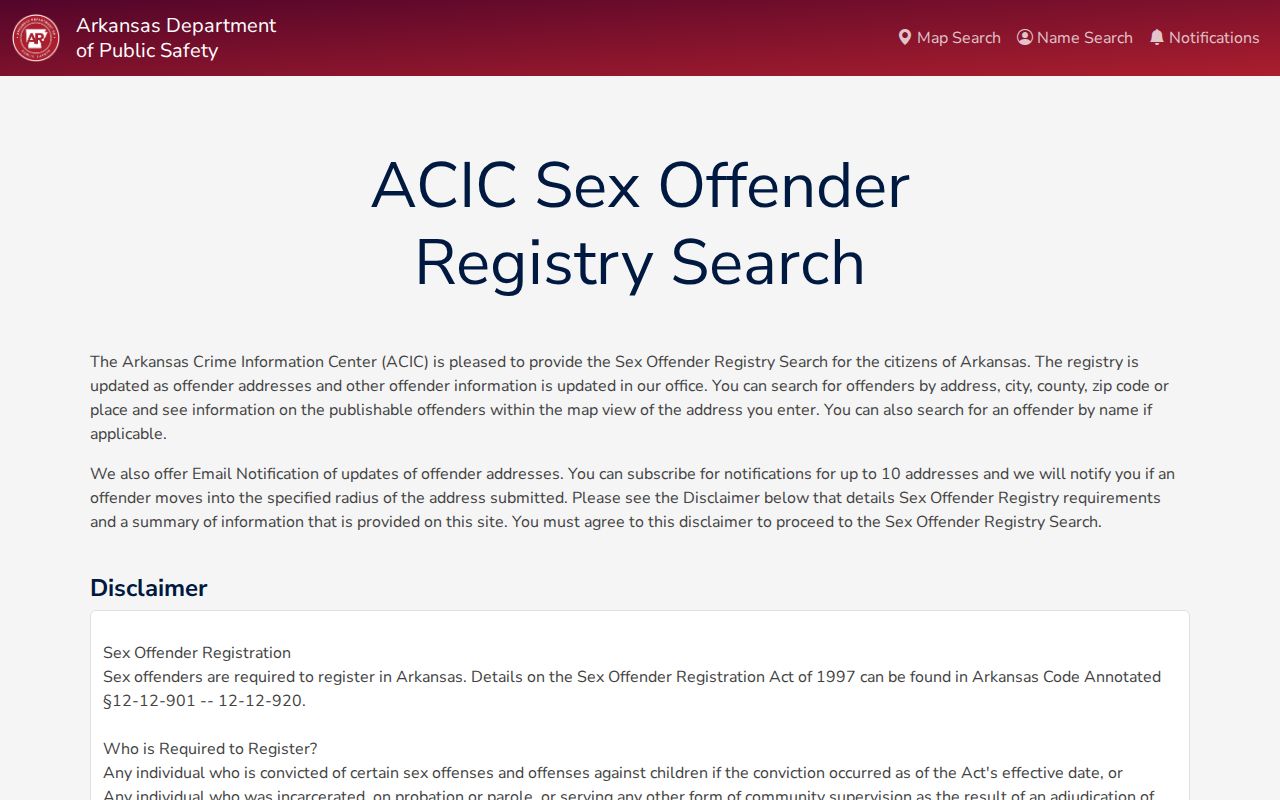
Its mix of name and place fields lets a reader move from a broad Lafayette County search to a more precise match.
Cross-State Lafayette County Registry Searches
The National Sex Offender Public Website is the next layer when a person or address history extends outside Arkansas. NSOPW brings together public registry data from states, territories, and participating tribal jurisdictions. It does not create a new criminal record. It routes the search through information supplied by each public registry, so state display rules still shape the results.
Use ACIC for the most direct Arkansas inquiry and NSOPW for a wider geographic check. If the national result points back to Arkansas, return to the ACIC profile for the state detail and use the Lafayette County sheriff channel for a local question. This comparison avoids a common error: treating a no-result response in one state as proof that no public record exists elsewhere.
The project's NSOPW source image marks the official nationwide search layer.
It works best as a supplement to ACIC, not as a replacement for Arkansas and Lafayette County contacts.
What a Registry Profile Shows
A public profile is a structured safety record. It may identify the registrant, show the current public location, summarize a qualifying offense, and state the Arkansas risk level. Some fields depend on display rules and the data supplied to ACIC. Read the profile as a whole, since a name or mapped point by itself cannot establish identity.
| Name and aliases | Published identity names that can help distinguish spelling changes. |
|---|---|
| Photo and description | Photograph plus traits such as sex, race, height, weight, hair, eyes, scars, marks, or tattoos when public. |
| Registered location | Address or mapped location subject to Arkansas display rules. |
| Offense details | Offense name and available statute, conviction date, or jurisdiction information. |
| Risk level | Arkansas Level 1 through Level 4 classification when publicly shown. |
| Status | Compliance or registration information and related dates when displayed. |
| Other public fields | Vehicles, employer or school information, registration agency, or county if ACIC publishes them. |
A registry profile is not the full Lafayette County court file. It may omit pleadings, hearing history, sentence orders, and details protected by law. Those belong to the court system and remain subject to sealing and confidentiality rules.
What Lafayette County Registry Profiles Leave Out
Registry publication answers a narrow public-safety question. It does not reproduce every police report, every count in a prosecution, or each event on a criminal docket. The offense label may be brief. A mapped address does not explain property lines or daily movement. A risk level is an Arkansas assessment category, not a forecast of a specific act.
For the filed charge and final outcome, search the proper court case. For local registration procedure, contact the sheriff. For state registry corrections, follow ACIC's official channel. Keeping those records separate reduces mistaken identity and prevents a short profile from being stretched beyond what its fields actually show.
Note: A registry entry and a court docket serve different purposes, even when both refer to the same Lafayette County case.
Registration Requirements and Levels in Arkansas
Arkansas uses four risk levels. Public visibility generally expands as the assigned level rises. The research supports practical level meanings and recognizes lifetime or long-duration registration for specified offenses or statuses, but it does not supply a universal term or verification frequency for each level. Those duties depend on the governing law and individual status, so the table avoids unsupported fixed schedules.
| Level or Status | Practical Meaning | Duration and Visibility |
|---|---|---|
| Level 1 | Lower-risk category | Public display can be more limited than at higher levels; duration is case-specific. |
| Level 2 | Moderate-risk category | Broader notification or visibility than Level 1; duration is case-specific. |
| Level 3 | High-risk category | Public profile visibility is expected; duration follows Arkansas law and status. |
| Level 4 | Sexually dangerous person or highest-risk category | Greatest public notification and law-enforcement attention; long-duration rules may apply. |
| Lifetime or long-duration | Specified offenses or statuses | Continues for the period required by Arkansas law. |
The governing framework appears in Arkansas Title 12 sex offender registration law. The captured Arkansas Title 12 source provides broader criminal-records context.
Statutory rules control registration and disclosure, while the live ACIC profile shows what is currently public for a particular registrant.
Lafayette County Registry App Map
The Lafayette County Sheriff AR app is a named local access channel, not a private registry copy. The app advertises a local sex offender map alongside the inmate roster, public-safety alerts, tips, and sheriff contact functions. It may present the county map more cleanly than the desktop route on a phone. Official listings are available through the Apple App Store and Google Play.
Use the app to reach county-facing tools, then confirm registry profile details in ACIC. Push alerts and local map features can aid awareness, but they do not change which agency owns the underlying record. ACIC remains the state publisher, and the sheriff remains the local registration office.
The manifest's official iOS listing image confirms the mobile route.
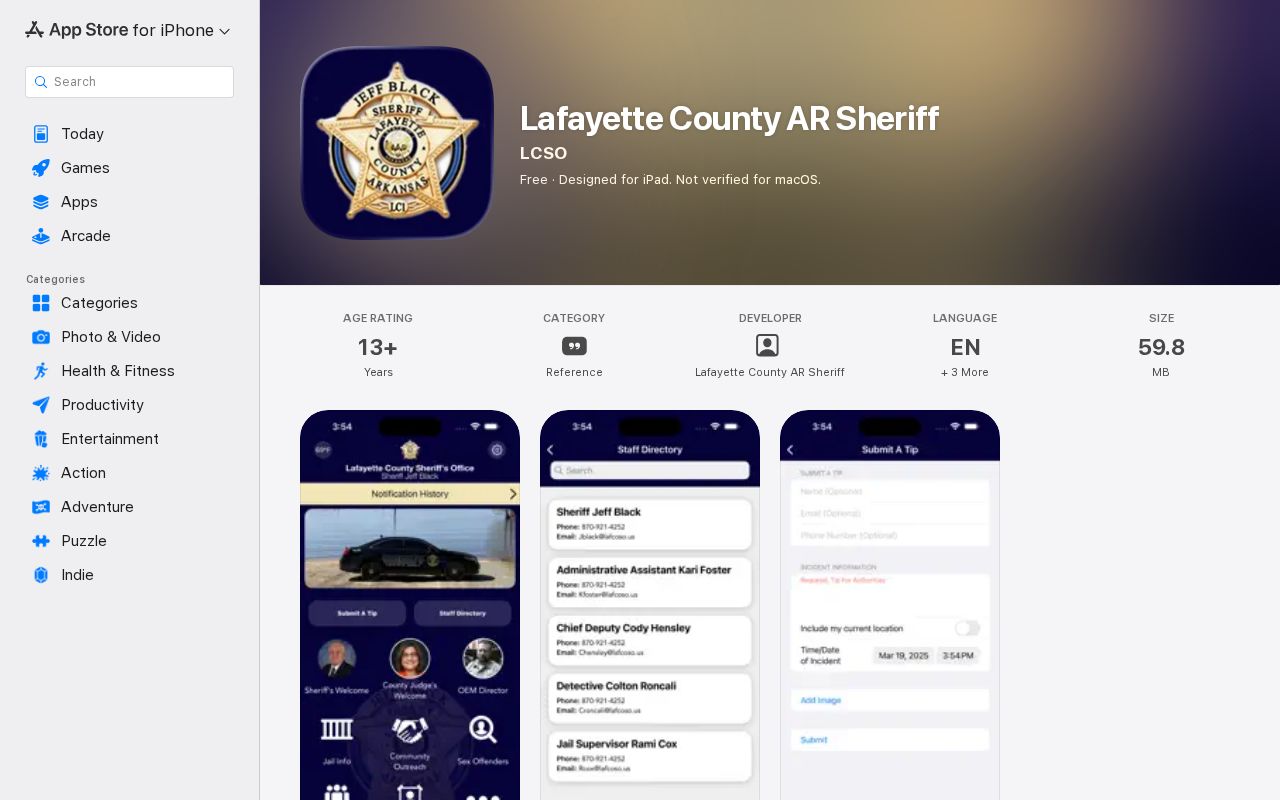
That mobile option is especially useful when the county map or contact features are easier to reach in the app.
Report Lafayette County Registry Noncompliance
Possible noncompliance should go to law enforcement, not social media or direct confrontation. Record the public profile, the issue observed, and the date, but do not investigate a residence or contact a registrant. The Lafayette County Sheriff's Office is the local point for county registration concerns. ACIC is the proper state channel when the problem appears to be a registry data error.
If there is an immediate threat, use emergency services. For a routine concern about an address, status, or registration duty, use the sheriff's official contact route and let trained staff compare the report with nonpublic registration records. A public profile alone may not reveal a recent update still being processed.
Lawful Use and Community Notification
Arkansas publishes sex offender information for public awareness and safety planning. Appropriate uses include reviewing conditions near a home, school route, park, or family gathering place and discussing age-appropriate safety rules. Community notification does not authorize threats, harassment, intimidation, or vigilantism. Nor does a public entry permit a reader to punish a registrant outside the law.
Misuse warning: Misusing registry information to harass, threaten, or intimidate a registrant or household can violate Arkansas law. Follow the lawful-use limits in Title 12, Chapter 12, Subchapter 9.
Report a safety concern through the sheriff rather than acting on it. Verify identity through several profile fields and check the live source again before relying on an old printout or screenshot. Registry information can change when an address, status, or risk assessment is updated.